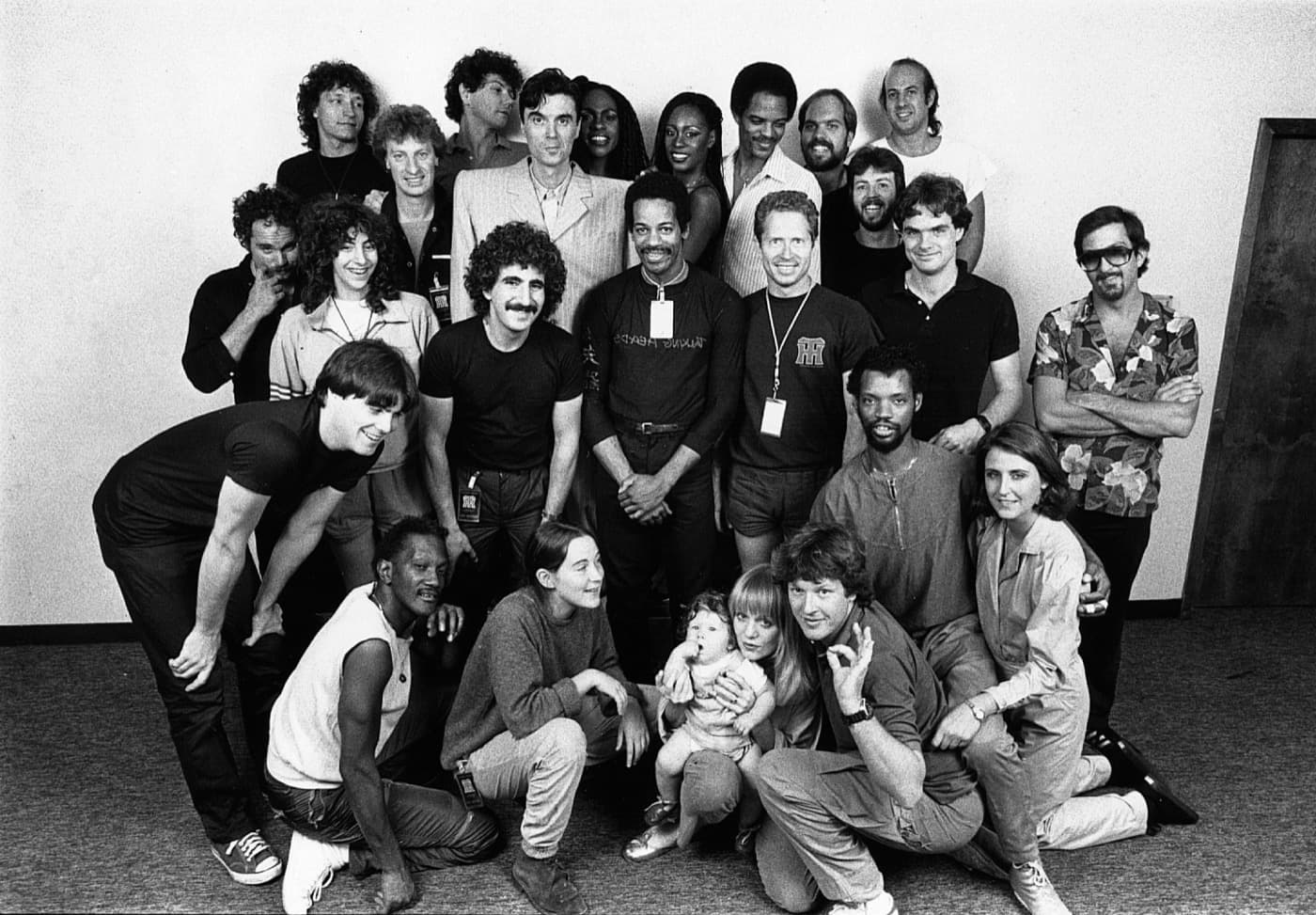
Hero photograph: Katie Elliott / Wikimedia Commons · CC BY 4.0.

A concert film can preserve a performance. Stop Making Sense makes the act of performing its story. It starts with a man, a guitar and a rhythm track, then lets a world of people and sounds gather around them. The movement from isolation to shared momentum gives the movie a shape that is satisfying even before you know the songs.
Released in 1984 and directed by Jonathan Demme, the film captures Talking Heads at Hollywood’s Pantages Theatre in December 1983. Its famous images are only part of the attraction. Look past David Byrne’s oversized suit and there is an ensemble whose work gives every change of scale its force.
Before the empty stage
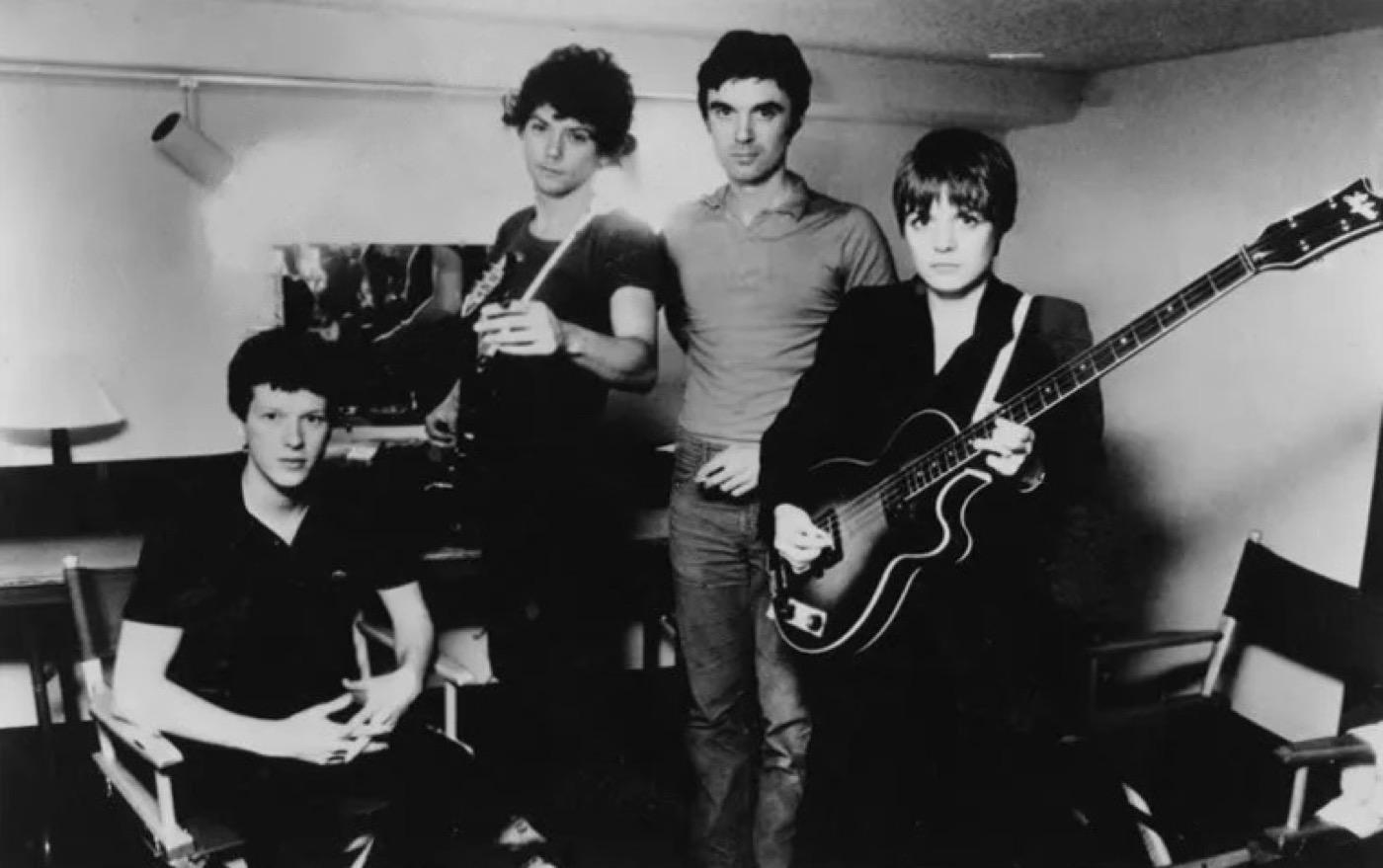

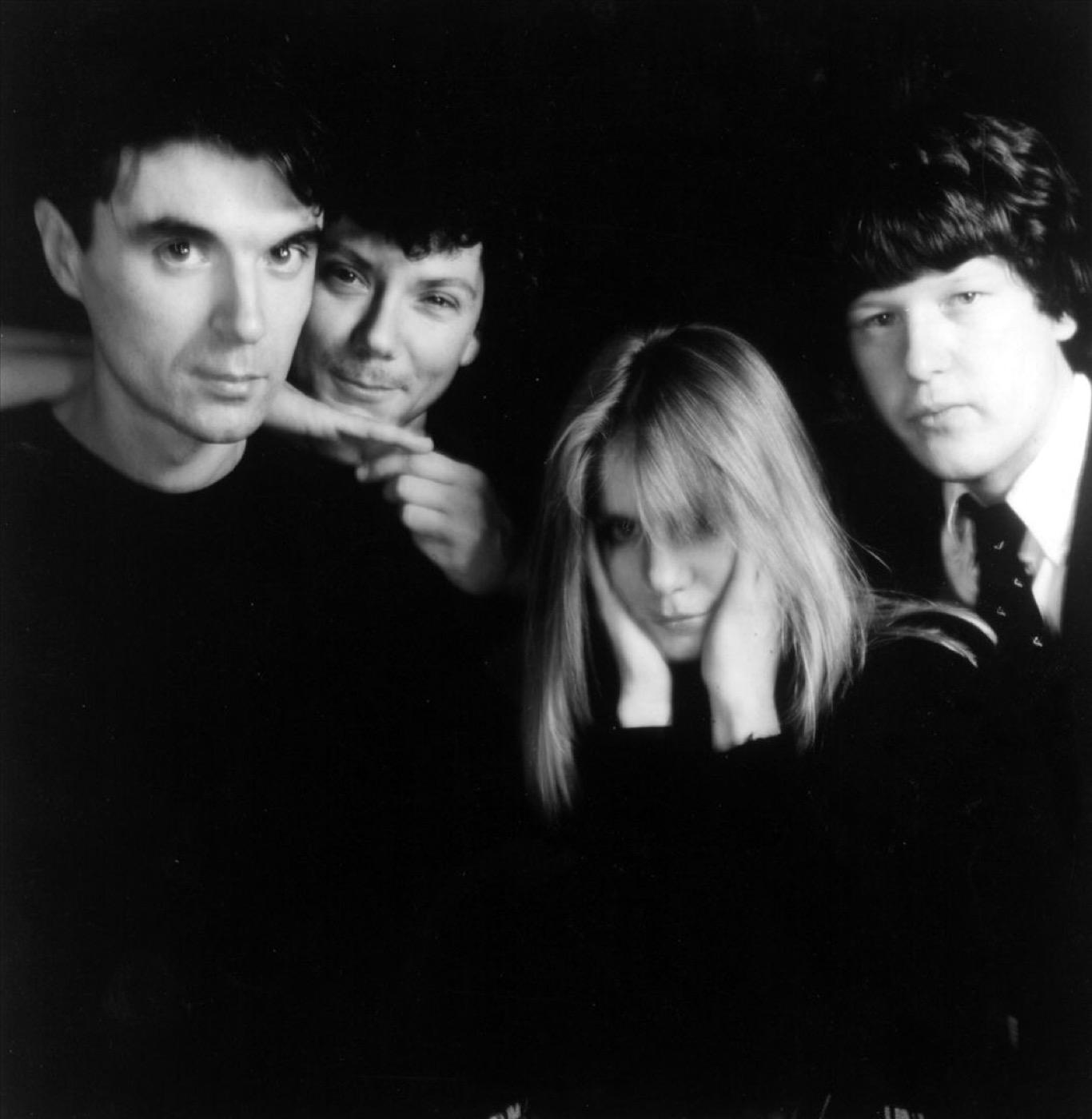
The photographs of Talking Heads from 1979 and 1980 show the quartet before the much larger ensemble seen in the film: David Byrne, Tina Weymouth, Chris Frantz and Jerry Harrison. They are useful context, but they are not production stills from Stop Making Sense. The distinction matters because the film makes expansion its central dramatic idea. A group becomes a community in front of the camera.
By the 1983 tour, the performance had room for additional voices, percussion, keyboards and guitar. Bernie Worrell, Alex Weir, Steve Scales, Lynn Mabry and Ednah Holt complete the nine-person company credited by A24. Their presence changes the scale of the music. The arrangements invite attention to exchanges between players, rather than treating the supporting musicians as decoration around the singer.
That is also a useful way to approach the movie. Watch the people at the edges of the frame. Listen for the rhythmic parts that keep going underneath a vocal phrase. The pleasure comes from discovering how much activity the songs can hold without losing their shape.
Three filming nights, one continuous experience
Jonathan Demme directed the film, with cinematography by Jordan Cronenweth and editing by Lisa Day. The AFI Catalog dates the principal filming to December 14–16, 1983, at Hollywood’s Pantages Theatre. The engagement began with a December 13 performance described in the production history as a practice run. That distinction helps explain why accounts refer to either three filming nights or four concerts.
The completed movie feels like an evening unfolding in one sustained movement. It is still a constructed film, assembled from performances across the engagement. Its continuity is an achievement of filmmaking as well as stagecraft: the spectator can follow the growth of the show without needing to keep track of camera positions or separate nights.
The photographs of the band and crew provide another perspective on that apparent effortlessness. There are many people behind an image that can look so spare. A bare stage does not mean an unplanned production; it means the production has chosen carefully what the audience should see.
The opening teaches us how to watch
Byrne begins with “Psycho Killer,” an acoustic guitar and a portable cassette player. The recorded rhythm gives him something to work against, but the large space around him remains conspicuous. Instead of announcing the full power of the band immediately, the film asks us to pay attention to a single figure and an exposed pulse.
The early songs add people in stages. Weymouth joins Byrne for “Heaven,” Frantz arrives for “Thank You for Sending Me an Angel,” and Harrison appears for “Found a Job.” The sequence is documented in AFI’s synopsis. It gives the audience an unusually clear introduction to the core band before the ensemble grows further.
There is a practical lesson inside that theatrical idea. A bass line becomes easier to notice when we have just experienced its absence. A drum kit changes the space when it arrives after relative sparseness. By letting us hear and see those additions, the show makes arrangement part of its story. We learn the sound by watching it take shape.
Nine people sharing the rhythm

With the full ensemble in place, the film’s character changes. The opening’s solitude gives way to a stage full of contrasting movements and musical responsibilities. The additional musicians have faces, gestures and individual energy. The result rewards looking beyond Byrne even when he is doing something impossible to ignore.
Weymouth and Frantz provide a center around which the other parts can move. Harrison’s guitar and keyboards contribute to the changing textures, while Worrell, Weir and Scales widen the instrumental conversation. Mabry and Holt give the vocal arrangements another physical presence: voices are attached to people who move together and respond to the music.
In his Fresh Air interview, Byrne connected the expanded performing lineup with a more sensuous, rhythm-centered way of moving. That recollection helps explain why the choreography feels connected to the playing. The body is another way of hearing the arrangement. A repeated step can draw our attention to a pulse that might otherwise pass unnoticed.
For a viewer, this changes what counts as a highlight. The biggest vocal moment is only one possibility. An exchanged glance, a coordinated movement or a small rhythmic accent can become just as satisfying. The film makes those details worth watching.
Demme’s camera makes room for the performers


The movie’s appeal depends on a productive relationship between stage and screen. The concert supplies people, sound, movement and light; the filmmaking decides how we encounter them. A shot can let us examine one player, or it can show how several bodies occupy the same rhythm. Both scales matter.
Rather than requiring interviews to tell us what the musicians mean to one another, the film lets performance carry that information. That does not make it a documentary history of Talking Heads. It is a concentrated encounter with a particular show. Viewers looking for an account of the band’s formation, business arrangements or private disagreements will need other sources.
The restraint is useful. We are free to notice expressions, changes of posture and the relationship between a singer and an instrumental response. There is room for humor without turning every strange movement into an explanation of Byrne’s personality. The image presents a performer doing something; the viewer can decide what the gesture suggests.
This is where Screen & Sound meet most directly. The songs would exist without the film, but the film organizes our attention in ways an audio recording cannot. You can hear a groove while looking away. You need to look back to see how differently each person inhabits it.
The big suit is a moving object
The oversized suit is the film’s most recognizable image, but it gains much of its effect from arriving after we have spent time with Byrne’s ordinary proportions. During “Girlfriend Is Better,” the relationship between his small head, wide shoulders and moving fabric becomes a performance in itself.
The film credits Gail Blacker with building the suit. In the Fresh Air conversation, Byrne described bringing a sketch to Blacker and drawing inspiration from the broad, rectangular shape of Japanese theater costumes. He explained that internal supports allowed the fabric to hang away from his body. Small movements could therefore produce a much larger visible response.
That construction is more revealing than treating the outfit as a visual joke alone. The cloth has its own timing. It follows, sways and briefly seems to move independently of the person inside it. Byrne can make a modest gesture and get an exaggerated silhouette in return.
There is no need to impose a single symbolic meaning on it. The suit is funny, strange and physically expressive before it stands for anything. Its continuing fame can obscure how carefully the rest of the show prepares us to enjoy that transformation.
A concert that changes its center
One of the film’s pleasures is that it can hand attention to someone else without losing momentum. The Tom Tom Club performance of “Genius of Love” gives Weymouth and Frantz’s other musical identity room inside the larger evening. Byrne’s absence from that number allows the center of the stage to shift.
Elsewhere, the difference between a sparse opening and a full arrangement becomes a source of suspense. Once the film has taught us that the show can change its shape, even a familiar song carries a question: what will these people do with it here? The interest lies in the present performance, as well as recognition of the title.
This is a good reason to watch the film in sequence. Individual clips preserve famous moments, but they cannot fully reproduce the relationship between arrival, accumulation and release. The large gestures are more persuasive because the film has made us attentive to the small ones first.
From the 1984 premiere to a renewed life
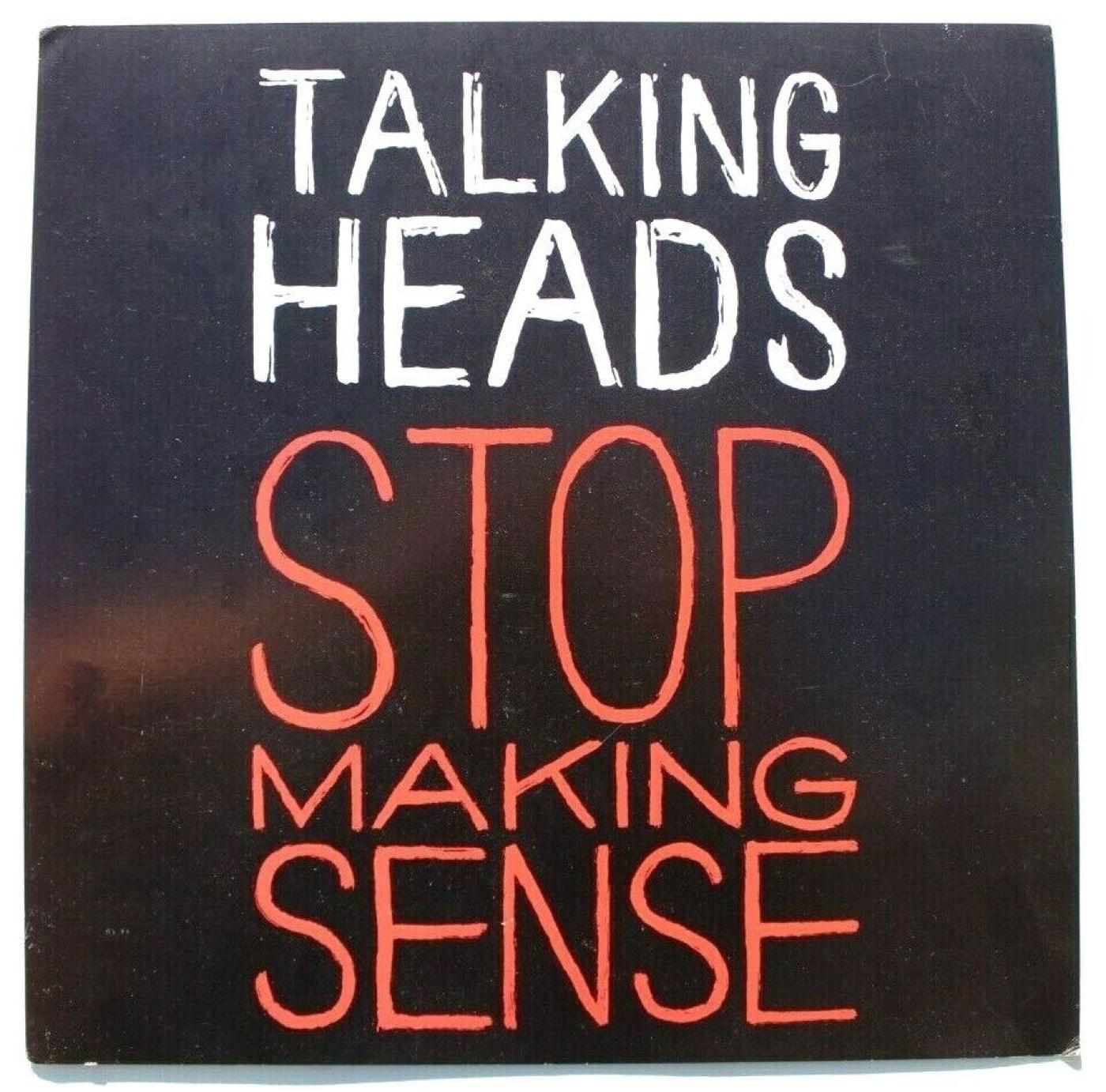

Stop Making Sense premiered at San Francisco’s Castro Theatre on April 24, 1984, according to AFI. The Library of Congress selected it for the National Film Registry in 2021. Those dates mark two different kinds of recognition: a new concert film entering circulation, and an established work being chosen for preservation.
A24’s restored anniversary edition brought the film back into circulation for another generation. Its official page documents the restoration and the home-video editions. The historical advertising image reproduced here belongs to the film and album’s earlier life; it is not artwork for the modern restoration.
The movie remains rewarding because its central proposition is easy to understand and hard to exhaust: put musicians together, give their work a clear visual form, and allow the audience to discover how the pieces connect. It offers enough memorable imagery for a first viewing and enough human detail for another.
Watch it once for the songs. Return for the bass line, the movement beside the microphone, the player waiting for an entrance, and the difference between a solitary figure and a stage full of people. Those relationships are the feature’s lasting subject.
Sources and photograph notes
Historical dates, production credits and the opening sequence were checked against the American Film Institute’s catalog. Ensemble credits and restoration information were checked against A24. Byrne’s comments on movement and the suit come from his Fresh Air interview, rebroadcast July 5, 2024. Registry selection is listed by the Library of Congress. Discussion of the film’s visual effect is critical interpretation.
All five images are reproduced from Wikimedia Commons, with individual source links and the rights information recorded on their file pages. Historical publicity photographs and advertising are identified as such. Images have been resized for the web; the inline photographs retain their full framing.